
Dammit, I miss Twitter. But admitting this is hard for me. I don’t want the person who purchased and broke the site to think he got to me, to think that this virtual page is spotted with liberal tears.
So don’t tell him that Twitter was like walking every day next to a stream that I could dip a toe into or leave behind in the woods if needed. I know there were toxins in the stream, but I had the Water Purifier of Truth (that is, I checked my sources) and I trusted that dilution would be the solution to the pollution.
My curated feed brought me the news I needed in a form that dovetailed with actual life: blurb, link, photo, leading to the question: “Do I need to know this?” Yes was a click, no a continued scroll. Maybe was a heart. Follow Up was a screenshot.
The stream comparison is natural because Classic Twitter caught the digital flow that cascaded from everywhere and channeled it to my feed, which I had carefully tended for 15 years.
And because I followed a lot of smart people, I was introduced to more smart people. It turns out there are a lot of wise, kind, dastardly funny people out there. And I did not have to meet them all for lunch!
So many times we doomscrolled through crises.


We reminisced.

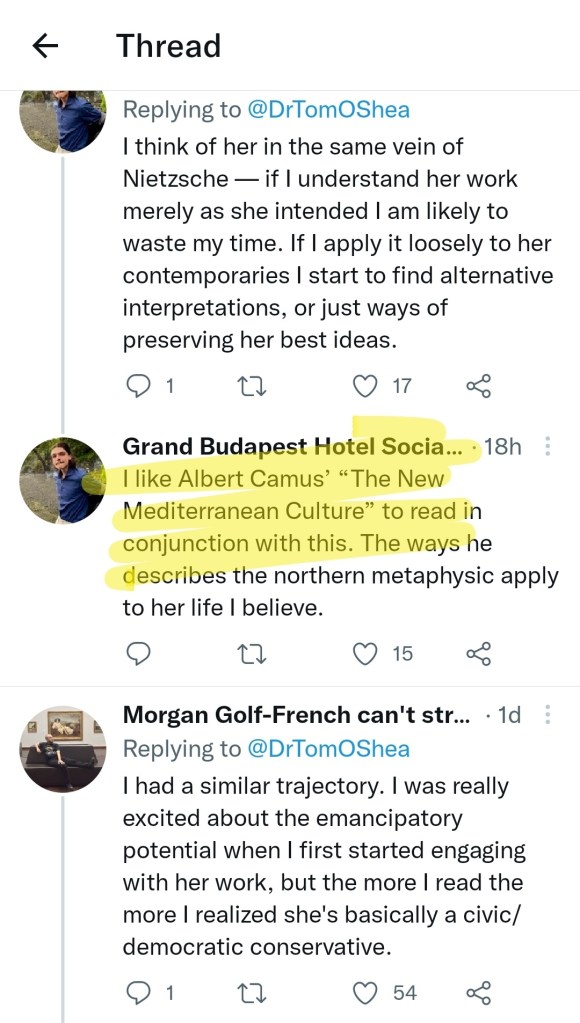
We got deep and recommended books.
And then there were the strange coincidences:

Like I said, some funny people out there:


Now I spend most of my time on Instagram, and yes, discussion happens there, too. But not yet like it did on Twitter, and not with the speed and reach that gave you a feeling that you knew the world, and that you were savvy enough to be around most people. Twitter was a news crawl; Insta is billboards on a highway, which may or may not tell me if my country just survived an attempted coup.
My decision to leave Twitter was not really mine, and that is the hardest part. What showed me the door was the growing incoherance of the app’s interface. My hand-selected feed was no longer selected by me.
Actually, the most troubling part of all of this is how we have lost what was a world-wide news source. We have splintered into a million directions and are now engaged in our own new learning curves and curated feed builds on multiple platforms. And we may reach a new consensus on a replacement for the ease and dexterity of Twitter. But right now, our atomization is dangerous.
Like it or not, Twitter became a de facto broadcast channel, like television or radio. If there was a meterological, environmental, political, or any other crisis, we all went to Twitter. You may have not been comfortable that a for-profit app carried forth news and helped with organizing around and responding to everything from the Arab Spring to the 2016 American election to Ukraine’s domination of the PR war over Russia. But that is how it evolved. My news knowledge right now is spotty and I am not sure how to fix that.
It’s hard to believe that the man who bought Twitter had anything in mind other than showing people he could. I know he has illusions of being a powerful thought leader, but he is more like the kid who tripped the teacher, laughed about it, and then everyone had to stay inside for recess. Yes, he wanted to stick it to liberals. But he also broke the world dialogue, and that should be a crime.
We, however, should not have essentially offloaded the dissemination of information and the medium for coordinating response to events to a startup in the first place. As we were watching the spackle-faced rocket boy giggle and pull Jenga blocks from a communication medium that overlaid all airwaves, personal devices, and information sources, I was hoping some international body would step in and take control, in the name of everyone’s safety and security. There is no body who can do this, and that means everybody is in danger. How can we talk now about the fragility of governments, about the next worldwide pandemic, about wars and what is true and what is misinformation and what is deliberate sabotage?
The urge to blame one man is strong, but only in fantasy movies is the evildoer one person. What stands as a gargantuan cultural and social bulwark against tyranny is the collective, “Not on our watch” that presents G-forces of resistance to those who are seeing how much they can get away with before their time is up. Soon, the typical person on earth will look like Zendaya and will vote in every election and and will make it clear (just as young legislators in some states have made it clear) that we are going forward together or we are going down together.
At least we have Wonder Woman on our side.

 Carol Morency